NIKKI COLLINSON-PHENIX
ADVISORY
Creator of Pressure Literacy®

The sick note is the end of the story, not the start
By the time someone's signed off, the pressure's usually been building for months. They've been coming in tired. Covering for colleagues. Answering emails at night. Saying they're fine, right up until their body says what they couldn't.
Most organisations respond with more support for the person. Counselling. A wellbeing day. An assistance line. None of that is wrong. But if work itself is creating the pressure, the person goes back into the same system, and the absence comes back with them.
Rising sickness absence is rarely just a health problem. Very often it's pressure, sitting in the system, landing on people until they can't carry it any longer.
What sickness absence is really costing you
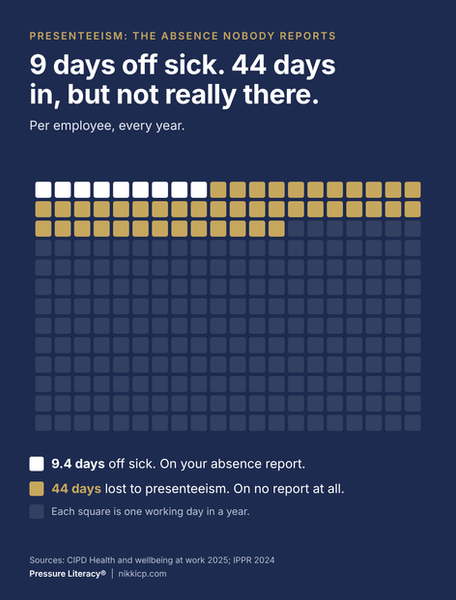
You'll already know the headline figure. Average sickness absence is now 9.4 days per employee a year (CIPD, 2025). Stress, depression and anxiety account for 22.1 million lost working days, 62% of all days lost to work-related ill health (HSE, 2025).
Then there's what it costs you in practice. The sick pay. The cover, agency staff or overtime. The colleagues carrying the extra work, who often end up next in line. The deadlines that slip, the quality that drops, and the hours you and your managers spend in absence meetings instead of running the business.
And the one nobody budgets for: presenteeism. People who come in, but aren't really there. That's 44 productive days lost per employee every year (IPPR, 2024), and it never shows up on an absence report.
Why your absence figures can't tell you the cause
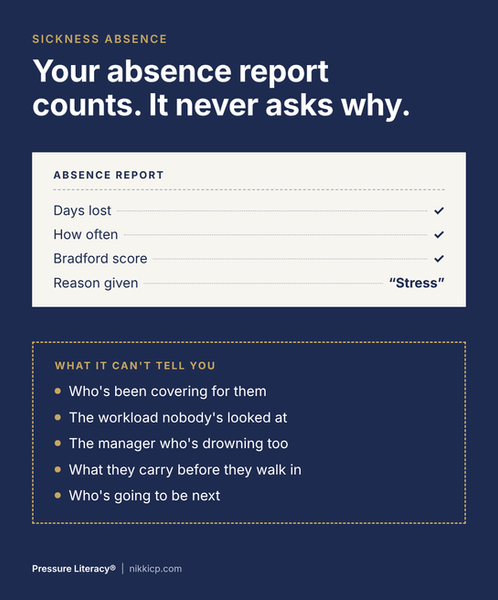
Absence systems count how often and how long. The Bradford Factor turns people's sick days into a score. What none of them ask is why.
Two people can have identical absence records for completely different reasons.
One is managing a health condition. The other is being crushed by a workload nobody's looked at.
Treat them the same, and you'll punish the wrong person and miss the real problem entirely.
Wellbeing can't fix a fracture
I'm not anti-wellbeing. Have the fruit, the mental health days, the yoga. But wellbeing helps people carry the load. Pressure Literacy asks why the load is that heavy.
A University of Oxford study of 46,000 workers found workplace wellbeing programmes made no impact on mental health outcomes (Oxford, 2024). That's not because wellbeing is bad. It's because it treats the person, not what's pressing on them.
A pattern I've seen. An organisation appoints a wellbeing lead, and picks its most caring, most capable person, who's already carrying a full load. Six months later, that person's signed off with stress. Nobody had looked at what they were already holding.
The early signs before the sick note
-
Short, frequent absences starting to cluster in one team.
-
People coming in unwell because they don't feel they can be off.
-
The same few people always covering.
-
Longer hours and emails sent late at night.
-
"I'm fine" being said a lot more than it used to be.
-
Your strongest people suddenly going off long-term.
Pressure always leaves early signs. Most leaders were never trained to recognise them. That's not a failing. It's a literacy problem, and it's fixable.
UK employers have a legal duty to assess the risk of work-related stress and act on it. Most measure the symptoms, like absence rates and survey scores. Very few can see where the pressure is actually coming from. The Pressure Gauge gives you that evidence, to inform your stress risk assessment and show you're acting on it.
How we find what's really driving your sickness absence
The Pressure Gauge Diagnostic shows you exactly where pressure is building in your organisation, who's carrying it, and what it's already costing you in absence, turnover and lost productivity.
It's independent, so people tell me what they won't tell their manager. The diagnostic instrument is anonymous, interviews are confidential, and nobody in your organisation ever sees individual responses. Those conversations also surface what people are carrying before they even walk through the door, because not everyone starts the working day in the same place.
You get a full written report, your Pressure Literacy Score, and a face-to-face debrief to walk you through it. It works for a team of 10 or an organisation of thousands, in any sector.
I'm 100% not here to criticise. I am here to partner with you.
I'm one hundred percent here to help you and your organisation do better, once we've got clarity on where you are right now. But I won't sugar-coat what I find, because softening the truth is exactly how organisations end up losing their best people.
I'm here to support you in uncovering the truth, with maybe a few uncomfortable conversations, to become a better leader and to support the positive growth of your business.
I've got you.

Questions leaders ask about sickness absence
What's a normal level of sickness absence?
The UK average is 9.4 days per employee a year (CIPD, 2025), but your own pattern matters more. If one team's absence is climbing, or the same people are always covering, that's your signal to look closer.
Is stress-related absence our responsibility?
If work is causing it, yes. Employers have a legal duty to assess and act on work-related stress. And even when the cause sits outside work, how your workplace responds makes a big difference to how quickly people get back.
Isn't this what our wellbeing programme is for?
Wellbeing supports people once pressure has landed. The Pressure Gauge finds where it's coming from, so less of it lands in the first place.
Can you help with individual sickness cases?
I don't manage individual cases. That's for your HR team and occupational health. I look at the system around your people, so fewer of them end up there.
Do you work with small businesses?
Yes. The Foundational diagnostic is built for organisations of up to 50 people, and the work is the same whatever your size.
Sickness creeping up and nobody can tell you why?
Let's talk. No commitment, no sales pitch. Just clarity.
Pressure never disappears.
It either becomes visible and readable, or it becomes expensive.
Get The Pressure Blind Spot Report. Free
Get The Pressure Blind Spot Report. Free. The five hidden costs behind your staff turnover and sickness absence that nobody is measuring.